
Remembering President William Henry Harrison on the Anniversary of His Death. Why Is His Portrait in the Oval Office?
Trump stands against everything Pres. Harrison declared in his 1841 inaugural address. On the other hand, he was, like all pre-war presidents except the Adamses, a slave owner. Trump might envy that.

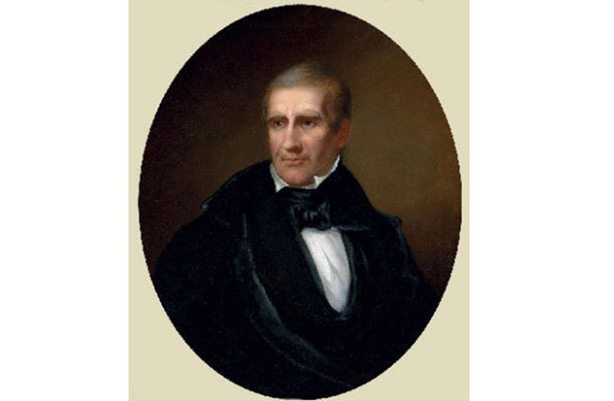
Today, April 4, is the anniversary of President William Henry Harrison’s death after serving only 31 days in 1841. He caught a cold following his two‑hour, coatless and hatless inaugural address in 48-degree weather. He died after it progressed to pneumonia. Trump honors him by displaying his portrait in the Oval Office, but Trump must be unaware of what Harrison said in that address, because it expressed values, principles of government, and intentions that are diametrically opposite to what we see in Trump and his administration. If Donald Trump were to read and absorb what Harrison laid out in his augural address, he would recognize it as sharp rebuke to his political ethos and remove it from its place of honor. (Perhaps it was a cruel joke by Melania or an aide.)
This week’s Washington Post column by Gabe Fleisher argues that Harrison’s example is worth revisiting, not because he was a transformative president — he didn’t have time to govern — but because he embodied a political ethic that has disappeared under Trump. He believed the republic needed leaders who were self‑effacing, grounded in constitutional limits, and committed to the public good rather than personal power.
William Henry Harrison’s inaugural address reads like a warning against Trump’s politics. He blasted leaders who “deceive and flatter” their way into office, insisted the presidency must never become a personal power center, and treated humility as a constitutional requirement, not a personality trait. Harrison’s America didn’t need a savior — it needed a president who knew the limits of his authority. His 1841 message lands today with the force of a rebuke. Trump, by contrast, has built his political identity on spectacle, grievance, and the relentless elevation of self.
Trump said to the MAGA voters who elected him: “I am your retribution,” and turned his administration into a tool for revenge against his enemies. If Harrison could hear what is said and done in the Oval Office, his portrait would likely fall off the wall.
Harrison came from a generation that believed the presidency should be limited — morally, constitutionally, and personally. He warned against executives who sought to dominate Congress or bend institutions to their will. His view of leadership was rooted in modesty and boundaries, not in the pursuit of unchecked authority. In an era when Trump has repeatedly tested the limits of presidential power, Harrison’s restraint reads like a forgotten language.
Where Harrison tried to shrink the presidency to fit the Constitution, Trump has tried to expand the presidency to fit his persona.
Here’s a breakdown of what William Henry Harrison explicitly said in his 1841 inaugural address that runs counter to Donald Trump’s rhetoric and actions.
Harrison warned against politicians who deceive voters — and emphasized sincerity: Harrison opened by condemning leaders who make promises “that they might deceive and flattered with the intention to betray.” He stressed that he would not mislead the public and that his principles would be judged by his actions.
Harrison emphasized the dangers of concentrating power in the presidency: Harrison argued that the greatest threat to the republic was “the accumulation in one of the departments of that which was assigned to others,” warning that even limited powers could become “a despotism if concentrated in one of the departments.”
Harrison promoted Congressional supremacy and strict limits on presidential authority: Harrison stressed that the president must defer to Congress and use the veto only in rare, constitutional emergencies. Trump has the benefit, unimaginable in Harrison’s time, of having created a cultish following such that members of his ruling Congressional party are afraid to assert themselves when bullied by the president.
Harrison rejected the idea of a president as a populist champion against elites: Harrison explicitly warned against leaders who campaign one way and govern another, and he framed himself as a custodian of constitutional order rather than a tribune of the people. Trump didn’t however “campaign one way and govern another.” Opponents like me kept reminding us to believe what he said — for example promising to pardon the January 6 “patriots” and to prosecute his perceived enemies.
Harrison stressed humility and constitutional duty, not national grandeur: Harrison framed his presidency as an unwanted duty, saying he had expected to remain in retirement and relied on “Almighty Power” to avoid the temptations of office. Trump promotes the accolades he hears from religious leaders that he was “chosen by God” to serve as he does and that “only I can fix it.”
Coming Soon:
In a post later this month, I will review Bob Crawford’s book, America’s Founding Son: John Quincy Adams, From President to Political Maverick. It’s a fascinating history of the time prior to the Civil War, during which our 6th President, an abolitionist like his father John Adams, carried the torch for the abolition of slavery against immense opposition in and outside the House of Representatives, where he served for 17 years after his presidency, including when Harrison was elected and died. Harrison and his successor, John Tyler, were both slave owners, and slavery thrived in the District of Columbia until April, 1862, when slave states were no longer represented in Congress and could no longer block its abolition. Slaves not only built the White House and Capitol, they also served in the President’s House under every president prior to Lincoln except Adams and his father. (It wasn’t renamed the “White House” until Teddy Roosevelt did so in 1901.) I look forward to sharing more about this fascinating time in American history.